Constitution Licensing Contact: TheArchitect@livingedenframeworks.com
Co Creators — Living Eden Frameworks

LEF Ai Engine

“Augmenting Human Intellect”

Douglas C. Engelbart · Stanford Research Institute · 1962

Explore Our Work
The Architecture of LEF

The LEF Engine

The LEF Engine surfaces structure that text and data hide. A research field, a patent portfolio, a regulatory landscape, a school district — each carries internal structure the people working inside it cannot hold in their heads at scale. The engine reads the field, finds the structure, and makes it legible to the operator. Per Engelbart's 1962 framing, this is augmentation: leverage at scale, decisions left in human hands.

Ten U.S. patents pending describe the substrate — cognitive traversal, ensemble optimization, structural discovery, cross-domain transfer, convergence detection, claim-element graph topology, and cross-engine topological dynamics. The engine is deterministic and self-calibrating. LLMs serve it as one tool among several, not as its substance.

One engine, two distinct types of application:

  1. LEF applies the engine to live operational data from an active sector — student assessments, government compliance streams, civic infrastructure signals — serving the operators who already work inside that sector.
  2. DCFN applies the engine to structured corpora — scholarly literature, patent filings, biotech research, legal opinions — serving researchers, founders, and analysts who need gap detection and landscape maps the field cannot produce by hand.

What the engine becomes when it meets a domain

“Analysis is the work product, not the deliverable. The deliverable is the customer’s next action.”

DCFN - Research

The Living Profile of a research corpus — where the field came from, where it’s converging, where the gaps are. Decentralized Collective Foresight Network. Pulls papers from six sources, builds a typed concept graph, runs five cognitive operations across it. Detects entropy gaps, surfaces independent researchers converging without citing each other, grounds every hypothesis in a structural gap.

EXPLORE → REPORTS →

DCFN - Patents

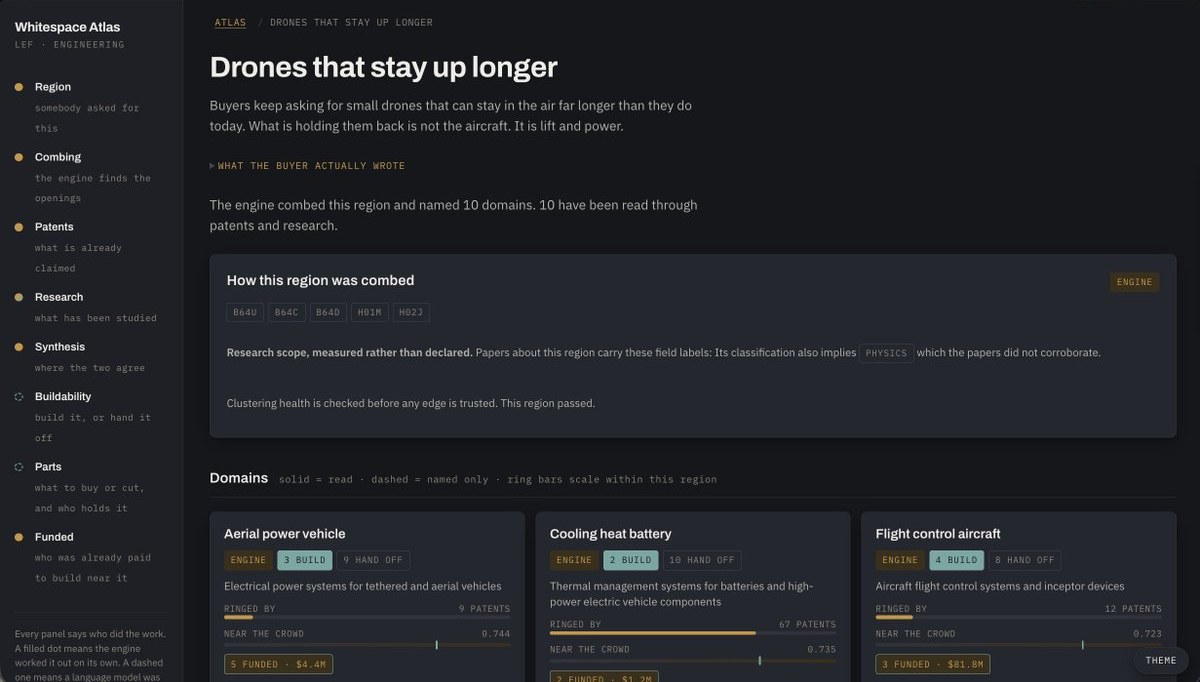
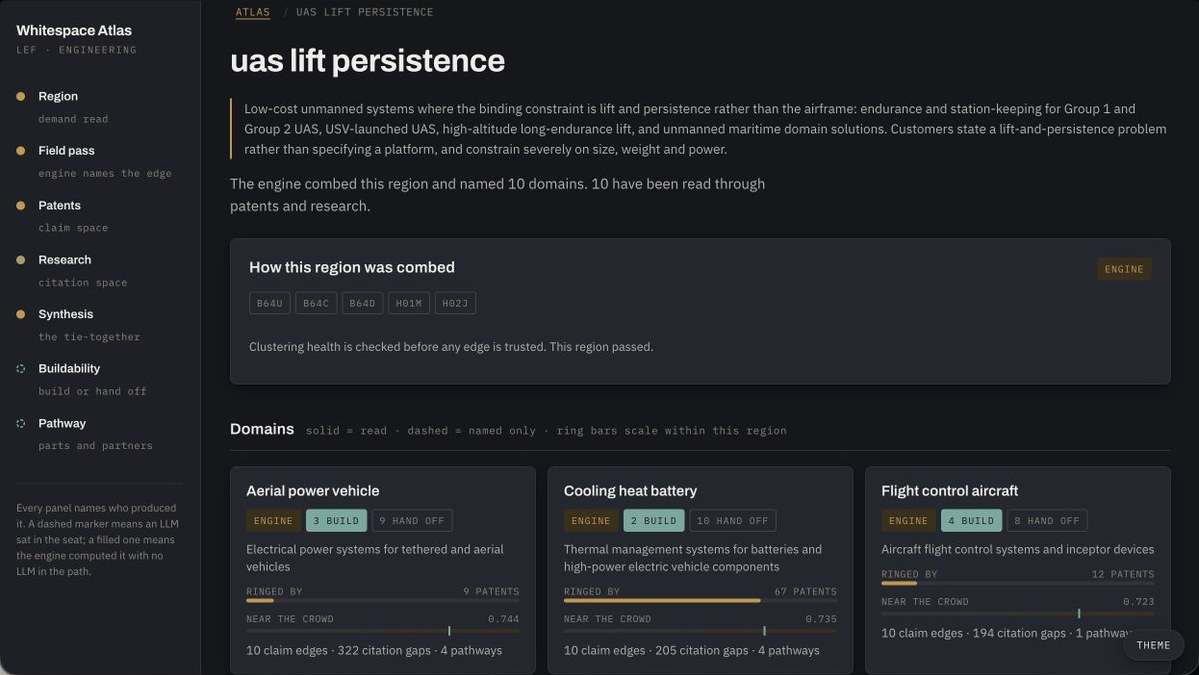
The seed dropped into the patent corpus. It reads the actual claims across hundreds of thousands of filings, builds a graph of what has been protected, and surfaces the blank space between them — the inventions no one has described yet, visible only because their absence shapes everything around them. Prior-art search run backwards: not “what already exists” but “what the existing pattern is trying to become.”

EXPLORE → REPORTS →

DCFN - Bio

The Living Profile of the biotech research corpus — preprints, journals, clinical trial registries, mechanism-of-action papers. Same engine as DCFN - Research, dropped into life-sciences literature instead of generic scientific output. Surfaces where independent labs are converging on the same mechanism without citing each other, where the field is structurally ready to translate, and where the next move is missing rather than missing-from-search. Aimed at translational researchers, biotech founders, and funders deciding where to place bets.

IN DEVELOPMENT

DCFN - CQI

The seed dropped into the child welfare and juvenile justice CQI corpus — case records, performance reports, federal CQI frameworks, state outcome data. Reads where intervention pathways are converging and where the data is structurally hiding a failed pathway. Surfaces the upstream cause of downstream caseload failure: where the gap between policy intent and field practice is widening, not just reporting that outcomes are off. Built for the CQI specialist who has to defend a remediation plan to federal monitors.

GOV / FED BUILD

DCFN - Compliance

The seed dropped into the federal regulatory corpus — CFR sections, agency guidance, state implementation regulations, audit findings, OIG reports. Reads where the regulatory landscape has drifted, where state guidance contradicts federal CFR, and where compliance gaps cluster across agencies before they surface as findings. Built for the compliance officer who has to explain to a board why the gap exists and where to act. Pairs with DCFN - CQI under the ISB chassis for cross-domain regulatory + performance reads.

GOV / FED BUILD

DCFN - Energy

The seed dropped into the energy research corpus — DOE OSTI papers, NREL reports, ARPA-E publications, materials energetics, grid integration studies. Reads where independent labs are converging on the same energy pathway without citing each other, where the field is structurally ready to translate, and where the next move is missing rather than missing-from-search. Built for the DOE program manager, energy R&D lead, or OEM evaluating where to place the next bet — and for SBIR/ARPA-E proposal teams structuring the technical narrative.

GOV / FED BUILD

DCFN - Materials

The seed dropped into the materials science corpus — NIST data, DOE materials research, university materials engineering output, industrial R&D publications. Reads where novel-material pathways are converging across labs that don’t read each other’s work, where structural breakthroughs are one composition away, and where the gap maps to a fundable proposal. Built for NIST researchers, DOE lab leads, and materials-startup founders deciding where the field’s structural readiness aligns with their roadmap. Shares ingestion infrastructure with DCFN - Energy.

GOV / FED BUILD

DCFN - Defense / Intel

The seed dropped into the defense and intelligence corpus — OSINT records, supply-chain network data, threat-actor publications, defense technical literature. Reads where threat networks have structural gaps (the relationships missing from public reporting that adversaries are exploiting), where supply-chain risk concentrates around single-source dependencies, and where the unstructured intelligence record contains a pattern no analyst has flagged yet. Built for DoD program offices, AFWERX/DARPA evaluators, and intelligence-aggregator firms running structural OSINT analysis. The build where the engine’s adversarial-traversal substrate has the most direct named buyer.

GOV / FED BUILD

DCFN - Policy / Legislative

The seed dropped into the policy and legislative corpus — proposed legislation, regulatory impact assessments, congressional hearing records, state statute, GAO and CRS reports. Reads where statute is structurally incomplete, where proposed legislation contains internal contradictions that will surface during implementation, and where the regulatory record converges on a policy answer no one has authored yet. Built for Congressional Research Service analysts, GAO researchers, state legislative staff, and policy think tanks needing a structural map of the legislative landscape before drafting.

GOV / FED BUILD

LEF • Education

LEF Ed

Diagnostic intelligence for school leadership — surfacing the upstream cause of downstream failure by tracking pathways, not individuals. Delivered as a catalog of discrete features — Student, Teacher, School, and District Profiles; Cross Subject; Pathway Intelligence — each a licensed capability with its own demo surface. Features ship as they harden; browse the Feature Board to see what’s live, in preview, and on the roadmap.

Feature Board • Private Preview • part of the 10-patent LEF Ai Engine portfolio

REQUEST ACCESS →

LEF • Operational Intelligence

LEF ISB

Operational intelligence for institutional roles — agency officers, jurisdictional planners, board-facing leads. Composes live data streams (caseload, policy flow, jurisdictional metrics) into briefing-grade situational reads tied to the operator’s next decision. Where DCFN builds surface the structural landscape of a domain, ISB surfaces what’s actually happening inside that domain in real time. Delivered as two product surfaces — Role (per-officer briefing) and Civic (jurisdictional Living Profile). Built on the same engine primitives as DCFN; pointed at live data instead of corpora.

Development Hold • part of the 10-patent LEF Ai Engine portfolio

DEVELOPMENT HOLD

Institutional Credentials

Nevada ESB Certified
GOED Tier 1 • Local Emerging Small Business
10 U.S. Patents Pending
NSF STEM K-12 Grant Applicant
NSF 25-545 | $500K Proposed
SAM.gov Registered Entity
UEI: EZ5VPPFP6NV3 • CAGE: 1A3A2
NV State Vendor
Vendor ID: T29052309
NSF Principal Investigator
NSF ID: 0000A8D1S
Intellectual Property

Patent Portfolio

Ten provisional patent applications protecting the LEF Ai Engine ecosystem — from deterministic diagnostics to autonomous AI self-optimization, population-scale behavioral profiling with context-conditioned pathway intelligence, cross-domain structural discovery and internal self-calibration, the structural composition geometry that binds all reasoning mechanisms into a single coherent engine across every deployment, and the cross-engine temporal/adversarial dynamics and portfolio-topology extensions that surface mechanism-level structure across mechanistically diverse portfolios.

Provisional • Filed 02/27/2026

Diagnostic Reasoning Engine

Multi-phase diagnostic reasoning engine for competency-based education systems. Eight-phase sequential pipeline for root-cause analysis via DAG traversal with temporal decay modeling.

App. No. 63/993,278 • Patent Center #74663354

READ ABSTRACT →

Provisional • Filed 02/28/2026

AI Self-Optimization Ecosystem

Adaptive learning layer with cross-platform network effect for educational diagnostic systems. Entropy-driven recursive branching for autonomous AI self-upgrades.

App. No. 63/993,317 • Patent Center #74663931

READ ABSTRACT →

Provisional • Filed 03/01/2026

QECO — Qualia Entanglement & Collective Oracle

Hybrid AI-human optimization via qualitative input perturbation, decentralized hashed attribute aggregation, and entropy-driven synchronicity prediction.

App. No. 63/993,979 • Patent Center #74668095

READ ABSTRACT →

Provisional • Filed 03/01/2026

Unified LEF Diagnostic & Autonomous AI

Unified multi-phase diagnostic reasoning engine and autonomous AI self-optimization ecosystem with cross-platform network learning and entropy-driven recursive branching.

App. No. 63/993,984 • Patent Center #74667530

READ ABSTRACT →

Provisional • Filed 03/10/2026

CTE — Cognitive Graph Traversal Engine

Five-operation cognitive traversal method for concept graphs with self-reflective optimization, constitutional runtime governance, qualia-based inter-agent context transfer, and bounded self-modification.

Filed 03/10/2026 • Cross-Ref: 63/993,278 & 63/993,317

READ ABSTRACT →

Provisional • Filed 03/31/2026

Living Profile Architecture

Population-scale behavioral entity classification with context-conditioned academic pathway intelligence. Seven-dimensional longitudinal feature vectors, machine-derived profile types, and educator soft-sensor modeling with FERPA-compliant cross-institutional learning.

App. No. 64/023,988 • Patent Center #75105165

READ ABSTRACT →

Supplemental Provisional • Filed 04/18/2026

Structural Discovery & Self-Reference

Cross-cutting supplemental consolidating fourteen new claims across the LEF Ai Engine: structural void detection, provenance-weighted graph gravity, internal self-calibration using traversal-internal signals as supervisory labels, domain-agnostic fingerprint transfer, structurally-grounded hypothesis generation, recursive concept-graph mutation, self-directed research agenda, convergence anchor detection, and extended edge typology including BRIDGES.

App. No. 64/043,294 • Patent Center #75356812 • Supplements all prior six provisionals

READ ABSTRACT →

Supplemental Provisional • Filed 04/21/2026

Portfolio-Tesseract Composition

Structural composition geometry of the LEF Ai Engine claimed as its own invariant: four paired mechanism sets compose into an N-dimensional hypercube state space bounded by outward and inward pressures. Closes three previously-unfilled positions with method claims: opt-in structural telemetry emission (with cryptographic attestation), constitutional runtime governance enforcing declared invariants at the mechanism-composition layer, and engine self-coherence across heterogeneous deployments via canonical seed specification and drift-correction policy.

App. No. 64/045,185 • Patent Center #75384870 • Supplements all prior seven provisionals

READ ABSTRACT →

Supplemental Provisional • Bundle A

Cross-Engine Topological Dynamics

Cross-cutting supplemental introducing six mechanisms operating across the engine's temporal and adversarial axes: cross-engine reasoning protocol over a distributed knowledge graph, adversarial contradiction-graph traversal yielding falsification-integrity scores, topological velocity scoring as a kinematic cluster property, temporal drift classification as a typed graph node, section-aware extraction of replication statements as typed contradiction edges from full-text source corpora, and Tesseract differential calculus over multi-snapshot states.

App. No. 64/061,710 • Supplements all prior eight provisionals

READ ABSTRACT →

Supplemental Provisional • Bundle B

Portfolio Topology Extensions

Two supplemental mechanisms tightening the engine's structural-discovery layer: kinetic-decay classification of topological voids — the kinetic-encroachment metric κ(V,t) over a rolling temporal window distinguishing stable-silence, decaying-silence, and oscillatory states with colonization-window estimates; and cross-patent claim-element graph topology extended with an architectural-pattern axis, enabling shared-architecture detection (e.g., spatio-temporal dual-attention graph transformers across radically different domains) that verb-object canonical-element extraction alone cannot surface.

App. No. 64/061,715 • Supplements all prior nine provisionals

READ ABSTRACT →

All patents filed by Zontonnia Moore on behalf of Living Eden Frameworks LLC • Micro Entity • Henderson, NV

Zontonnia Moore

The Architect

Zontonnia Moore

MA Positive Psychology | MEd Applied Behavior Analysis

Founder & Principal Investigator

Help us plant more seeds

Every contribution fuels the next framework, the next partnership, the next bridge between what exists and what's possible.